3D, AI or Both? How to Choose the Right Production for Your Game Trailer
When game providers brief us on a trailer, one question comes up more and more: “Should we do it in 3D or with AI?” It’s the right question, but the answer is rarely one or the other. Each approach has real strengths, and the best results usually come from combining them.
Classic 3D animation: precision and control
Traditional 3D animation and motion design means building every character, symbol and environment as a 3D model, then animating, lighting and rendering it.
Best for:
- Exact fidelity to your game art and symbols
- Precise camera moves and choreographed action
- Assets you’ll reuse across many formats and future games
- Product shots where every detail must be correct
Trade-off: more production time per shot, especially for complex organic scenes like crowds, weather or realistic humans.
AI-driven production: speed and richness
AI-driven production uses generative tools, guided by art direction, to create images, environments, characters and motion.
Best for:
- Exploring many visual directions quickly at the concept stage
- Rich, cinematic environments and atmospheres
- Realistic characters and human performances
- Concept teasers and tight timelines
Trade-off: less frame-by-frame control. Without strong art direction, results can look generic. That’s why the creative team matters more than the tool.
The hybrid pipeline: why we use both
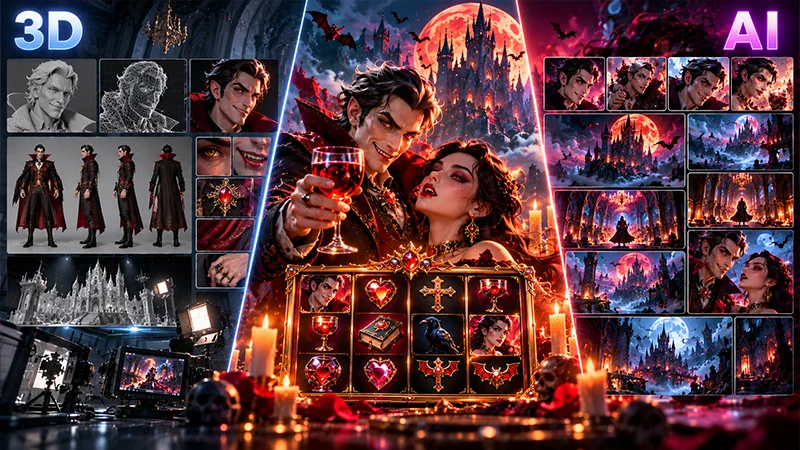
Most of our recent trailers combine the two. A typical hybrid production looks like this:
- AI for exploration. Mood boards, style frames and world concepts in days, so you choose a direction with real images in front of you.
- 3D for the core. Your game symbols, logo and key characters are built in 3D for accuracy and reuse.
- AI for the world around them. Environments, atmospheres and cinematic sequences that would take weeks in pure 3D.
- Compositing and finishing. Everything is unified with lighting, colour grading, VFX and sound into one cinematic piece.
The result: cinematic ambition, delivered on a launch or event timeline.
How to decide for your game
- Is your game art the hero? Lean 3D, to keep symbols and characters exact.
- Is it a concept or pitch? Lean AI, to show the vision fast.
- Do you need a world, not just a game? Go hybrid.
- Will you reuse assets for sequels and events? Make sure the core is built in 3D.
What doesn't change
Whatever the tools, a trailer stands or falls on the same things: a strong story, clear art direction, great sound and a team that understands gaming audiences. Tools change every few months. Craft doesn't.
Back to the start
This article closes our launch series. Start again from the beginning with How to Promote Your New Slot Game, or see how launches connect to trade shows with Drive To Booth™.
Launching a new game?
Tell us about it. We’ll show you what its trailer could look like.